
Level Sensors & Transmitters
HCT100 Capacitive Level Controller
5 relays, RS485
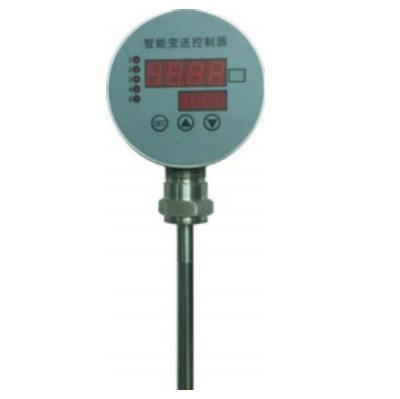
HCT100 technical data
Measurement
- Measuring range
- 100–5000 mm
- Sensor type
- Coaxial capacitance
- Accuracy class
- 0.2 or 0.5
- Sampling rate
- 4 readings per second
- Display range
- −1999 to 9999
- Long-term stability
- 0.5 % FS/year
- Power supply effect
- ≤ 0.1 % FS
Electrical
- Supply voltage
- DC 24 V, AC-DC 110 V, AC-DC 220 V
- Power consumption
- ≤ 3 W
- Analogue output
- 4–20 mA / 0–10 or 20 mA / 0–5 or 1–5 V DC
- Relay outputs
- 5 pairs
- Relay rating
- 5 A at 250 V AC, 5 A at 30 V DC
- Relay life
- > 100 000 operations
- Communications
- RS485
- A/D conversion
- 24-bit
Mechanical
- Ambient temperature
- −20 to +70 °C
- Medium temperature
- −20 to +80 °C
- Storage temperature
- −40 to +100 °C
- Relative humidity
- 0–80 %
- Housing material
- Aluminium alloy
- Probe material
- Stainless steel
- Connection
- G1/2, M20×1.5 or to order
- Ingress protection
- IP65
Values are for the standard configuration. Ranges, threads, probe lengths and output types outside this table are available on request — the datasheet revision for a custom build is issued with the quotation.
Request the PDF datasheet →Level Sensors & Transmitters
HCT100Capacitive Level Controller
5 relays, RS485
Coaxial capacitive level transmitter and controller, 100–5000 mm, with 24-bit A/D, five relays, RS485 Modbus and selectable analogue output. Handles viscous and coating media where float instruments would seize. 316 stainless probe.
Engineering reply · Evaluation samples available · Custom ranges built to order
- No moving parts — suits viscous and coating media
- 24-bit A/D for small capacitance changes
- Five relays plus RS485 Modbus
- Range 100–5000 mm
- 316 stainless probe, IP65 housing
How it works
Capacitance measurement uses the medium itself as the dielectric between two coaxial electrodes. As the level rises, more of the probe is immersed, the capacitance changes, and the electronics convert that to a level. There is no float to jam and nothing that needs to move, which is why capacitive instruments are used on slurries, viscous products and media that coat — the three cases where a float switch stops working. The 24-bit front end resolves the small capacitance change, and five relays plus RS485 cover both local control and supervisory reporting.
Ordering notes
- The dielectric constant of the medium affects the reading; a calibration on the actual product is required, not on water.
Typical applications
- Viscous and paste-like products
- Slurries and suspensions
- Media that coat or crystallise on metal
- Chemical tanks with aggressive contents
Not certain HCT100 is the right unit?
Send the medium, range, process connection and the signal your control system accepts. We will confirm the model — or tell you which one fits better — before you commit to an order.
Same family
Other level instruments
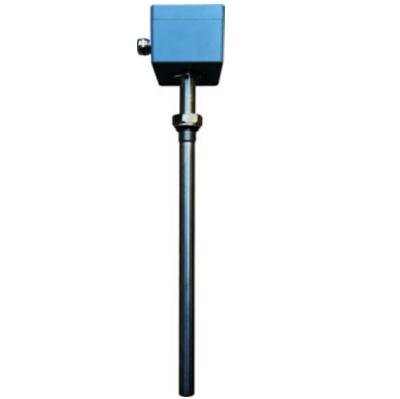
Capacitive Level Controller
2 relays
Coaxial capacitive level controller with two relay outputs, LED display and 24-bit A/D. 100–5000 mm, 4–20 mA / 0–10 V / 1–5 V selectable, stainless probe. The compact option for simple high/low control on viscous media.
View specifications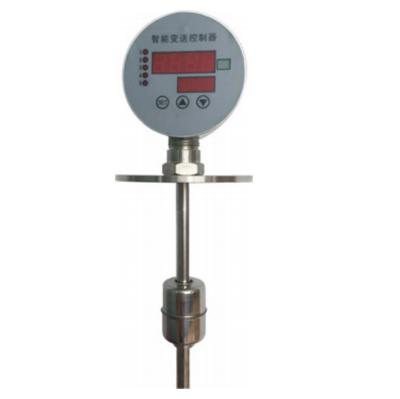
Magnetic Induction Level Controller
5 relays, dual supply
Five relay outputs plus 4–20 mA or 1–5 V, keypad-configured, with dual 24 V DC / 220 V AC supply so it can be wired straight into an existing panel. LED display, IP67, range to 3000 mm.
View specifications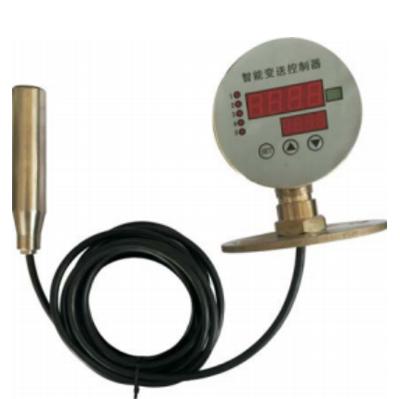
Submersible Level / Pressure Controller
5 relays, RS485
Five relay outputs plus RS485 Modbus and selectable analogue output, in the 100 mm round case. 0.5–300 m range, dual 24 V DC / 110–220 V AC-DC supply, high-brightness dual-row LED. For pump control with remote supervision.
View specifications
Rod Float Level Switch
1–4 set-points
Discrete level switch with one to four magnetic reed points on a stainless guide rod. Passive dry contacts need no power supply, and the reed elements never touch the liquid. Rod diameter 9–25 mm, pressure to 6.3 MPa, temperature to 150 °C.
View specifications