
Level Sensors & Transmitters
HPS10 Submersible Level Transmitter
Hydrostatic, IP68
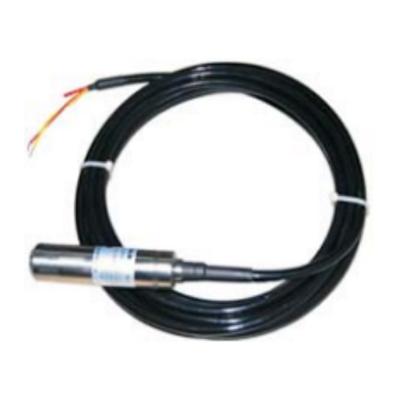
HPS10 technical data
Measurement
- Range
- 0.05–300 m
- Accuracy class
- 0.1 or 0.2
- Response time
- 1.0 ms
- Temperature effect
- 0.03 % FS/°C
- Long-term stability
- 0.2 % FS/year
- Safe overload
- 5× range (ceramic-capacitive); 2× range (piezoresistive)
Electrical
- Supply voltage
- DC 24 V (12–32 V)
- Output
- 4–20 mA
- Load impedance
- 750 Ω
- Insulation resistance
- ≥ 100 MΩ at 100 V DC
Mechanical
- Medium temperature
- −20 to +80 °C
- Ambient humidity
- 0–100 % RH
- Probe material
- Stainless steel
- Ingress protection
- IP68
Values are for the standard configuration. Ranges, threads, probe lengths and output types outside this table are available on request — the datasheet revision for a custom build is issued with the quotation.
Request the PDF datasheet →Level Sensors & Transmitters
HPS10Submersible Level Transmitter
Hydrostatic, IP68
Hydrostatic level transmitter for wells, reservoirs and sumps. Range 0.05–300 m, 4–20 mA two-wire, 0.1 or 0.2 accuracy class, ceramic-capacitive or piezoresistive sensor. Ventilated cable prevents condensation, IP68.
Engineering reply · Evaluation samples available · Custom ranges built to order
- Range 0.05–300 m
- Accuracy class 0.1 or 0.2
- Ventilated cable for accurate atmospheric reference
- Condensation-resistant vent design
- IP68, fully submersible
How it works
The HPS10 measures hydrostatic head: the pressure at the bottom of a column of liquid is proportional to its height, so a pressure sensor lowered to the bottom of a well reads the level directly once you enter the density. The ceramic-capacitive element is temperature-compensated and linearised before the 4–20 mA conversion, and the accuracy class is 0.1 or 0.2. A ventilated cable equalises the reference side with atmosphere so barometric changes do not appear as level changes, and the vent design resists condensation, which is the usual failure mode for submersible transmitters in cool wells.
Ordering notes
- Enter the medium density into the calibration; a transmitter set for water will over-read in brine and under-read in light hydrocarbons.
Typical applications
- Deep wells and boreholes
- Reservoirs and dams
- Sump and wet-well level
- Canal and river gauging
Not certain HPS10 is the right unit?
Send the medium, range, process connection and the signal your control system accepts. We will confirm the model — or tell you which one fits better — before you commit to an order.
Same family
Other level instruments
 Illustrative image
Submersible Level Transmitter
Local display
The HPS10 hydrostatic transmitter with a local display head, so the level can be read at the well head. 0.05–300 m, 4–20 mA, accuracy class 0.1 or 0.2, IP68 probe, condensation-resistant vent.
View specifications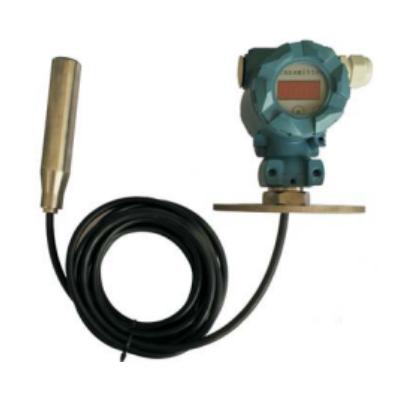
Submersible Level Controller
4 relays
Submersible hydrostatic transmitter with a 24-bit A/D front end, LED display, four relay outputs and 4–20 mA / 0–10 V / 1–5 V analogue output. Range 0.5–300 m, alarm points set from the keypad, stainless and aluminium housing.
View specifications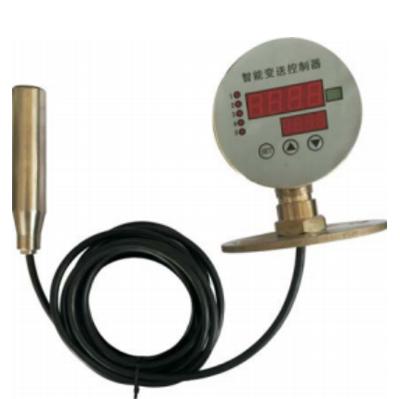
Submersible Level / Pressure Controller
5 relays, RS485
Five relay outputs plus RS485 Modbus and selectable analogue output, in the 100 mm round case. 0.5–300 m range, dual 24 V DC / 110–220 V AC-DC supply, high-brightness dual-row LED. For pump control with remote supervision.
View specifications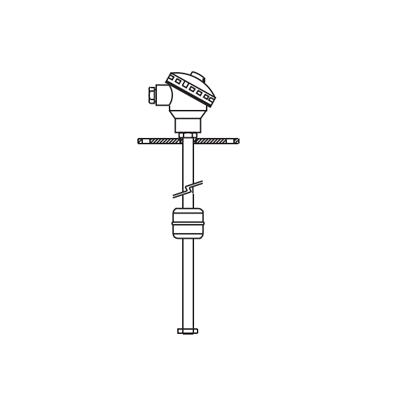
Rod Float Level Switch
1–4 set-points
Discrete level switch with one to four magnetic reed points on a stainless guide rod. Passive dry contacts need no power supply, and the reed elements never touch the liquid. Rod diameter 9–25 mm, pressure to 6.3 MPa, temperature to 150 °C.
View specifications